We have submitted a manuscript on our principle project. This is the period of calm that lays between the rush to submit and the time before one receives comments from the reviewers. The manuscript describes how human cancer cells undergo checkpoint adaptation: a sort of "double or nothing" cellular game in which cells will divide even though they have damaged DNA. The manuscript connects the dots of hundreds of observations described in the literature where mitosis has been observed in cells treated with DNA damaging agents. We have mapped this terrain in a systematic fashion. We then go beyond mapping by proposing a mechanism to explain the steps to enter mitosis under these conditions. The important bit is that once you have a good map you can plan where you should go next.
Please feel free to contact me for more information or for a preprint, while the calm lasts.

Wednesday, 7 March 2012

Tuesday, 21 February 2012
Science Education
February is shaping up to be education month. Working in research has the additional benefit of highlighting areas of science education that need to be strengthened. On 16 February I gave a lecture at the University of Calgary to students in the Cancer Biology course on the topic of Checkpoint Adaptation. The textbook version states that cells with damaged DNA will die by apoptosis; everyone is surprised to learn that cells first enter mitosis and that some of these survive.
This week I'm invited to participate in the Life Science Inspired Teaching Symposium in Toronto. A leading Canadian science publisher is bringing scientists to the table to discuss the methods of teaching science. One view is that students live is a noisy and distracting education world, we need to ensure that the science message gets their attention. The month ends with another Checkpoint Adaptation lecture to the graduating biology class at the U of Lethbridge. As usual, I will include a slide or two about Louis Pasteur.
This week I'm invited to participate in the Life Science Inspired Teaching Symposium in Toronto. A leading Canadian science publisher is bringing scientists to the table to discuss the methods of teaching science. One view is that students live is a noisy and distracting education world, we need to ensure that the science message gets their attention. The month ends with another Checkpoint Adaptation lecture to the graduating biology class at the U of Lethbridge. As usual, I will include a slide or two about Louis Pasteur.
Wednesday, 18 January 2012
2012
A New Year
We had the pleasure of hosting a French stagiaire in the laboratory and we wish her luck with her studies back in France. An undergraduate has moved onward to a co-op position after helping set up the video microscopy and winning 1st place in oral presentation of his work. The video microscopy technique provided insight into the number of cells in population that undergo checkpoint adaptation. The current team is now working on applying new techniques to measure enzyme activity and DNA damage in treated cancer cells so that we can predict better the mechanisms that drive checkpoint adaptation.
We had the pleasure of hosting a French stagiaire in the laboratory and we wish her luck with her studies back in France. An undergraduate has moved onward to a co-op position after helping set up the video microscopy and winning 1st place in oral presentation of his work. The video microscopy technique provided insight into the number of cells in population that undergo checkpoint adaptation. The current team is now working on applying new techniques to measure enzyme activity and DNA damage in treated cancer cells so that we can predict better the mechanisms that drive checkpoint adaptation.
Friday, 4 November 2011
A new publication - Chk1 inhibitors
We have a second publication out this year. This work is a major collaboration between chemists and biologists to find new chemical inhibitors of the enzyme Chk1. The chemistry was led by Dr Françoise Perron-Sierra and Dr Patrick Casara; they developed a new method to modify an amazing class of compounds known as "indolocarbazoles". By testing these new molecules we found several potent inhibitors of Chk1. These compounds add to our arsenal of tools to study how cancer cells enter mitosis with damaged DNA. The compounds also have potential as anti-cancer agents in solid tumours and leukaemias.
If you have questions or would like to know more, feel free to contact either myself (roy.golsteyn@uleth.ca) or Françoise (francoise.perron-sierra@fr.netgrs.com).
If you have questions or would like to know more, feel free to contact either myself (roy.golsteyn@uleth.ca) or Françoise (francoise.perron-sierra@fr.netgrs.com).
Thursday, 27 October 2011
Judging a scientific journal by its cover
This doesn't happen every day....
The pile of journals that I wanted to read was already too high and the 6 October 2011 issue of Nature had just arrived. So I placed Nature beside the pile, turned to grab my sandwich, and then reached to open this new issue. I realized, however, I had opened The Biochemist. So I closed The Biochemist and there it was, the same cover on Nature and on The Biochemist.
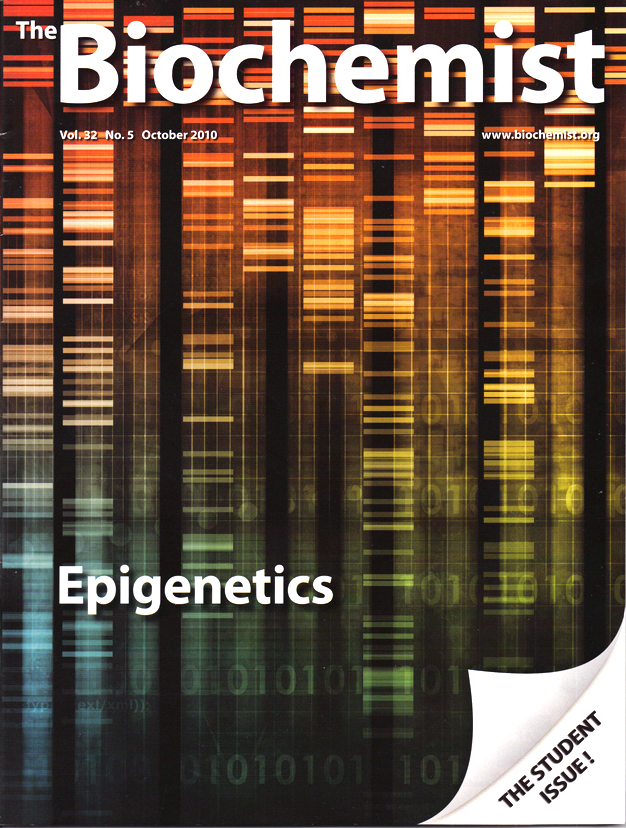
 Well not quite the same cover, if one has an eye for gels or electropherograms, one will see that lanes 6-11 on the Nature cover are the same as lanes 1-6 on The Biochemist cover. Back to the important part.... reading the contents.
 Saturday, 22 October 2011
Mitosis or apoptosis (life or death)
Our laboratory has invested much time and effort in developing an experimental model of how human cells can divide even when they have damaged DNA. The efforts are beginning to pay off. Recently we found that when cells enter mitosis with damaged chromosomes, they can inactivate apoptosis. Perhaps this should not be too surprising because mitosis should cause all the alarms to sound (loss of contact, changes in organelles, DNA everywhere). The rub is to know if cancer cells use this as another mechanism to survive. We are now examining the pathways that might provide survival. A new area for us, which was illuminated by our model and a pharmacological approach.
Friday, 16 September 2011
New Academic Year - New Laboratory Members
A new academic year begins with much promise and optimism. This year we are optimistic because we have two new graduate students and two new undergraduates joining the laboratory. New people mean new ideas and more energy to tackle the hard problem of how cancer cells divide. We are also optimistic because the our cell based model seems to hold the answers to what are the biochemical pathways that enable cancer cells to divide, when they should not. One enzyme, Checkpoint kinase 1, is clearly important but we also find that it is not acting alone. With help from the new recruits we are working to find the master regulator of checkpoint adaptation
Subscribe to:
Posts (Atom)